The scale and speed of modern jobsites make total manual oversight impossible. By embedding artificial intelligence in construction safety workflows, safety managers and project leaders can now capture what human eyes might miss. Enlaps combines cutting-edge site cameras with cloud-based analytics to deliver proactive risk mitigation, transforming data into life-saving actions.
💡
Key Takeaways - AI in Construction Safety
Predictive Risk Mitigation: Shifts site safety from reactive accident investigation to proactive prevention, using computer vision to flag hazards and behavioral anomalies before injuries occur.
Computer Vision Lookout: Transforms passive cameras into active digital lookouts that continuously track worker locations, heavy machinery buffer zones, and structural shifts.
Automated PPE & Zone Alerts: Automatically scans active workspaces to verify hard hat/high-vis compliance and triggers instant alerts if personnel breach digitally geofenced hazard zones (e.g., blast zones or crane radii).
Streamlined Compliance & ROI: Replaces manual paper logs with automated daily safety performance reports, reducing Total Recordable Incident Rates (TRIR), simplifying OSHA audits, and lowering insurance premiums.
Privacy-First Surveillance: Solves worker trust and surveillance concerns by integrating native data anonymization features, focusing strictly on hazard/safety tracking rather than personal profiling.
Autonomous Safety Infrastructure: Utilizes the Enlaps Tikee ecosystem (solar-powered 6K panoramic cameras + cloud analytics) to blend macro-level project tracking with micro-level safety verification without requiring jobsite power grid infrastructure.
What Is AI in Construction Safety?
At its core, ai in construction safety refers to the deployment of machine learning models, computer vision, and connected sensors to detect, analyze, and prevent workplace hazards. Instead of relying solely on physical walkthroughs or reviewing footage after an incident occurs, automated technology turns visual data into actionable safety metrics.
How AI Is Changing Construction Site Safety
Integrating specialized computer vision models transforms passive cameras into active digital lookouts. These smart systems process imagery from high-risk zones, instantly flagging anomalies and generating automated compliance logs.
Why Traditional Safety Monitoring Has Limits
Traditional Environmental Health and Safety (EHS) tracking depends on sporadic field audits. Human safety inspectors cannot be present in every sector of a multi-acre project simultaneously, creating dangerous blind spots in hazard detection and security.
The Shift From Reactive to Predictive Safety
By analyzing patterns and trends over time, advanced construction ai monitoring shifts the industry away from reacting to accidents toward predictive prevention. Identifying minor non-compliance trends early prevents catastrophic events later.
How AI Improves Construction Site Security Monitoring
Security and worker health are deeply intertwined on complex infrastructure projects. Understanding how ai improves construction site security monitoring requires looking at the continuous analysis of visual assets captured across the jobsite.
Real-Time Hazard Detection on Jobsites
Smart software constantly scans active workspaces to identify high-risk conditions. Whether it is an open leading edge, an ungrounded electrical asset, or an improperly secured scaffold, the system maps vulnerabilities autonomously.
AI-Powered Video Monitoring and Computer Vision
Through sophisticated computer vision algorithms, neural networks are trained to recognize objects, people, and spatial relationships. This enables the platform to monitor heavy machinery proximity and structural movements continuously.
Detecting Unsafe Behaviors Before Accidents Happen
Human behavior is dynamic, but unsafe habits are often repetitive. By tracking behavioral anomalies—such as climbing without tie-offs—ai for construction safety software provides a critical window for corrective training before an injury occurs.
Monitoring Multiple Construction Sites Remotely
Project stakeholders can oversee safety indicators across an entire national portfolio from a centralized dashboard. Remote visual intelligence ensures that corporate safety standards are maintained uniformly across all field teams.
Core AI Technologies Used in Construction Safety
Implementing a robust digital defense system requires a blend of multiple technical assets working in perfect harmony.
Computer Vision for PPE and Worker Detection
Computer vision serves as the foundation for modern site analytics. It translates standard high-resolution image data into classified assets, differentiating between a worker wearing a safety vest and someone missing proper protective equipment.
Predictive Analytics for Risk Prevention
Historical site data, current weather conditions, and active work phases are cross-referenced using predictive models. This allows safety teams to receive high-probability risk forecasts for specific days or activities.
Wearable Sensors and Connected Safety Devices
Smart vests, connected helmets, and proximity beacons feed spatial data into the central system, keeping track of worker locations and biometrics relative to heavy equipment.
AI Drones and Autonomous Site Inspections
Unmanned aerial vehicles equipped with autonomous mapping software conduct scheduled site surveys, generating 3D models that identify shifting topographical risks or unstable structural elevations.
Smart Cameras and Environmental Monitoring
Enlaps’ specialized hardware and cloud solutions act as the perfect vehicle for this transformation, turning panoramic, long-term visual documentation into data-rich environmental and operational safety assets.
DEMONSTRATION - 30 MINUTES
See the Tikee Solution in action at a construction site like yours
An expert shares their screen with a real-world project connected to the myTikee platform.
Connecting cameras
Managing different camera angles
AI Dashboard
People-blurring feature
No obligation · Time slots available quickly
Practical Applications of AI in Construction Safety
Field deployment demonstrates how theoretical technology translates into immediate, tangible field protection.
Fall Detection and Prevention
By monitoring perimeter zones and scaffolding layouts, the system detects missing guardrails or unauthorized personnel near high-elevation edges, preventing fall injuries before they happen.
PPE Compliance Monitoring
Automated tracking screens for hard hats, high-visibility jackets, safety glasses, and proper footwear. A centralized log tracks overall compliance percentages to help tailor tool-box talks.
Equipment Collision Avoidance
Ground operations utilize spatial AI to monitor safety buffer zones around excavators, cranes, and heavy transport, alerting supervisors when personnel step into dangerous blind spots.
Heat Stress and Fatigue Monitoring
Correlating extreme climate data with site activity tracking helps project managers mandate structured rest cycles during hazardous weather thresholds.
Restricted Area and Hazard Zone Detection
Geofenced perimeters can be digitally overlaid on site views. If a worker or subcontractor enters an active blast zone or crane radius, an immediate alert is triggered.
Fire, Structural, and Environmental Risk Alerts
Early computer vision indicators pick up early signs of smoke, localized flooding, or unexpected structural leaning, minimizing asset loss and protecting lives.
AI Construction Monitoring for Safer Jobsite Operations
Safety cannot operate in a silo; it must be deeply integrated into daily construction and operational workflows.
Using AI to Improve Daily Site Supervision
Supervisors use visual intelligence to run safer morning briefings. Access to automated data points allows them to focus physical inspections where risks are mathematically highest.
Automated Safety Reporting and Documentation
Ditch paper logs. The software automatically compiles daily safety performance records, providing an objective audit trail for corporate compliance and insurance verification.
AI Insights for Safety Managers and Project Teams
Aggregated analytics reveal long-term behavior patterns, such as declining compliance during Friday afternoon shifts, allowing managers to execute targeted safety interventions.
Combining AI Monitoring With Timelapse and Visual Tracking
The Tikee ecosystem excels by marrying safety analytics with pristine 6K panoramic timelapse footage. This provides project owners with both the grand macro view of project progress and micro-level safety verification.
Benefits of AI for Construction Safety
Investing in construction safety with ai delivers distinct operational advantages that protect both human lives and financial capital.
Reducing Workplace Injuries and Near Misses: Continuous ai construction safety surveillance flags hidden patterns, lowering Total Recordable Incident Rates (TRIR).
Improving OSHA Compliance and Audits: Continuous visual verification provides solid documentation, shielding companies from costly citations and legal liability.
Lowering Insurance and Operational Costs: Insurers reward data-driven safety cultures. Proactive risk logging can lower premiums and avoid expensive project stoppages.
Increasing Visibility Across Large Projects: Bridge the gap between corporate headquarters and remote sites with standardized digital reports.
Creating a Stronger Safety Culture: Transparent data motivates teams to take personal accountability, making safety a collaborative habit rather than an enforced rule.
ENLAPS SHOP
Total Monitoring Packs
Revolutionize visual project monitoring.
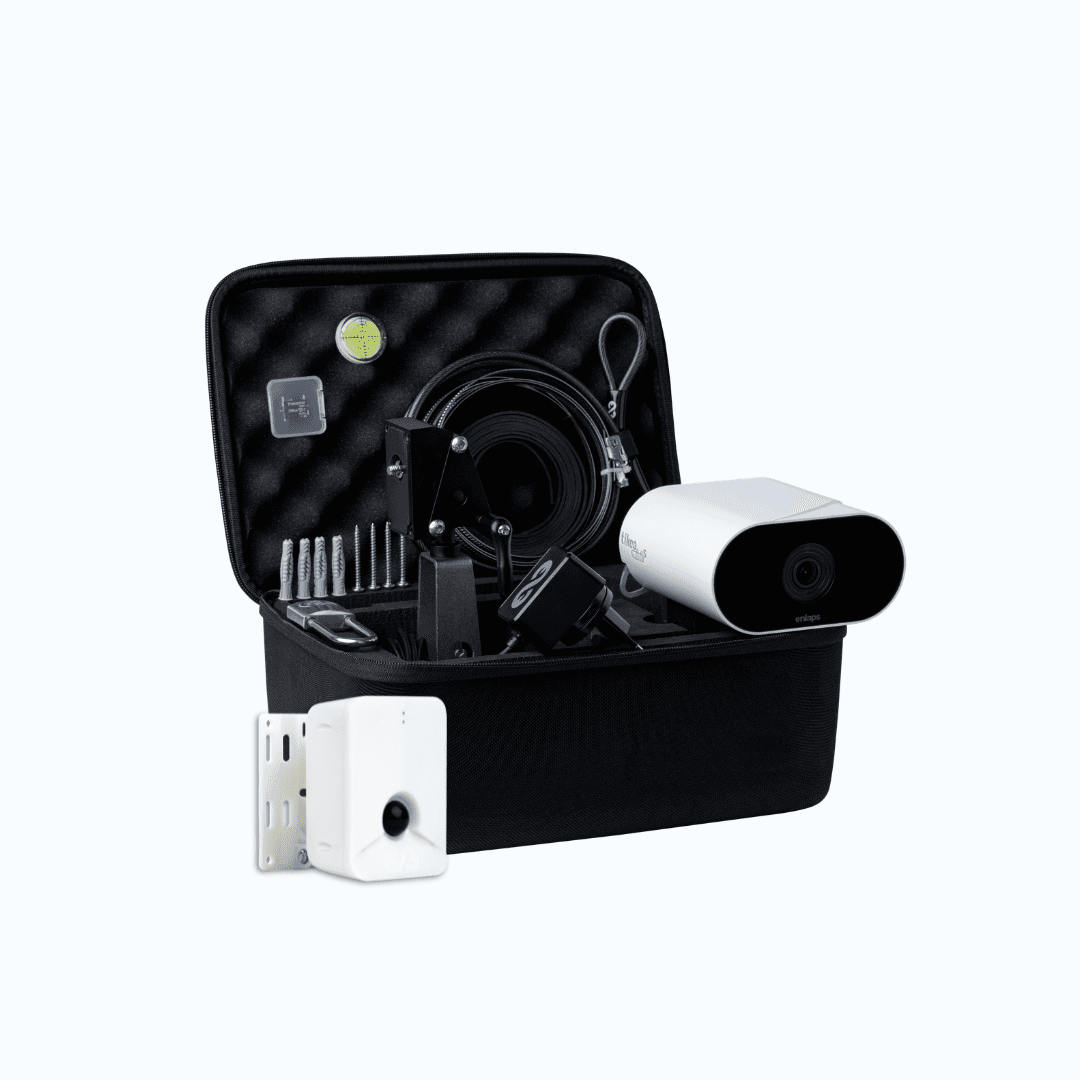
Total Monitoring Pack - Tikee mini S
1.548€ excl. tax

Total Monitoring Pack - Tikee 4X
2.547€ excl. tax
Made in France · Express Shipping · Trade-In Offer
AI Safety Tools Used in the Construction Industry
The marketplace consists of a specialized ecosystem of hardware and SaaS platforms designed for harsh field environments.
AI Cameras and Computer Vision Platforms
Fixed and autonomous cameras serve as the sensory inputs for site intelligence, collecting raw footage required for complex deep-learning interpretation.
Predictive Safety Analytics Software
Cloud engines ingest multi-source field data, translating raw imagery and logs into predictive charts and immediate push notifications.
Smart Wearables for Construction Workers
From sensors embedded in boots to clips on safety vests, wearables provide localized proximity awareness and slip-and-fall telemetry.
AI-Powered Construction Monitoring Solutions
Enlaps stands at the forefront of this category, supplying heavy-duty, solar-powered Tikee cameras that feed cloud-based analytics, offering continuous security and safety validation without demanding on-site power infrastructure.
Challenges and Limitations of AI in Construction Safety
A balanced implementation requires addressing the natural technical and social hurdles of automated workplace monitoring.
Privacy and Worker Trust Concerns
Workers may feel uncomfortable under constant camera surveillance. Enlaps solves this by integrating native data anonymization features, focusing strictly on safety compliance and object detection rather than personal surveillance.
False Positives and Data Accuracy
Irregular lighting or specific clothing patterns can occasionally trigger false warnings. Continuous algorithmic training is mandatory to keep analytics highly accurate.
Connectivity and Infrastructure Requirements
AI cloud computing demands constant data uploads. Solutions must leverage dependable 4G LTE/5G routing to remain effective on remote infrastructure sites.
Cost and Integration Challenges
Legacy companies often struggle to connect new software with old workflows. Choosing an accessible ecosystem with robust API integrations prevents data silos.
Why Human Oversight Still Matters
AI flags anomalies, but it cannot replace human judgment, empathy, and professional leadership. Technology is an amplifier for skilled safety professionals, not a replacement.
How to Implement AI in Construction Safety Programs
Succeeding with digital safety transformation requires a phased, strategic rollout plan.
Identify the Highest-Risk Activities: Pinpoint your primary historical hazards—such as heavy machinery traffic or high scaffolding work—to direct initial AI model training.
Start With a Pilot Construction Project: Test the cameras, notification lag, and field team reactions on a single site before scaling across the entire company.
Integrate AI With Existing Safety Processes: Feed automated alerts into your current communication channels, ensuring safety officers can act on data instantly.
Train Teams and Build Adoption: Educate sub-contractors and laborers on the system’s goals, proving that the technology is there to protect them, not to punish them.
Measure Performance With Safety KPIs: Track the reduction of close calls, PPE non-compliance events, and safety response speeds to quantify your return on investment.
The Future of AI in Construction Safety
Autonomous, connected, and highly integrated ecosystems are reshaping tomorrow’s jobsites.
Predictive and Autonomous Safety Systems
Future iterations will instantly communicate with heavy equipment, automatically shutting down machinery if an un-alerted person walks into an operational swing radius.
AI-Powered Digital Twins and Smart Jobsites
Real-time 3D models will mirror physical site progress, continuously running predictive safety simulations based on real-time worker movements.
Generative AI for Safety Documentation
Contextual site data will auto-generate flawless EHS documentation, tailoring hazard analyses to shifting weekly conditions.
Robotics and Automated Hazard Prevention
Robotic quadruped dogs and automated systems will manage dangerous night-time structural inspections, eliminating human risk entirely.
DEMONSTRATION - 30 MINUTES
See the Tikee Solution in action at a construction site like yours
An expert shares their screen with a real-world project connected to the myTikee platform.
Connecting cameras
Managing different camera angles
AI Dashboard
People-blurring feature
No obligation · Time slots available quickly
Frequently Asked Questions About AI in Construction Safety
How is AI used in construction safety?
AI is deployed through computer vision platforms that analyze visual feeds from site cameras. It tracks compliance with protective equipment, detects spatial hazards, monitors restricted zones, and generates automated risk logs for safety personnel.
Can AI reduce accidents on construction sites?
Yes. By transitioning from reactive investigation to real-time, predictive hazard detection, it flags unsafe patterns—like failing to wear proper PPE or entering machine clear zones—allowing supervisors to correct behaviors before injuries occur.
What are the best AI tools for construction safety monitoring?
The best solutions combine rugged site-proof hardware with cloud-based computer vision. The Enlaps Tikee ecosystem provides an industry-leading option, offering self-powered, high-resolution visual capture paired with automated data analytics.
Does OSHA allow AI safety monitoring systems?
Yes, OSHA encourages the use of advanced technology to foster safer working conditions. AI monitoring provides objective visual evidence of compliance and helps companies uphold strict safety standards.
Is AI construction monitoring expensive to implement?
While advanced infrastructure carries upfront costs, cloud-based visual monitoring options significantly lower traditional barriers. The long-term return on investment is massive when factoring in reduced injuries, zero OSHA fines, and lower insurance premiums.
Can small construction companies use AI safety tools?
Absolutely. Scalable cloud networks mean smaller firms do not need large internal IT servers. Deploying standalone, solar-connected cameras allows growing contractors to utilize enterprise-grade safety analytics easily.